Guides on building AI agents usually end with a list of frameworks. We will walk through what companies actually ask about: the order of work, what it costs across three routes, how long it realistically takes — and what safeguards must be in place before an agent touches customer data.
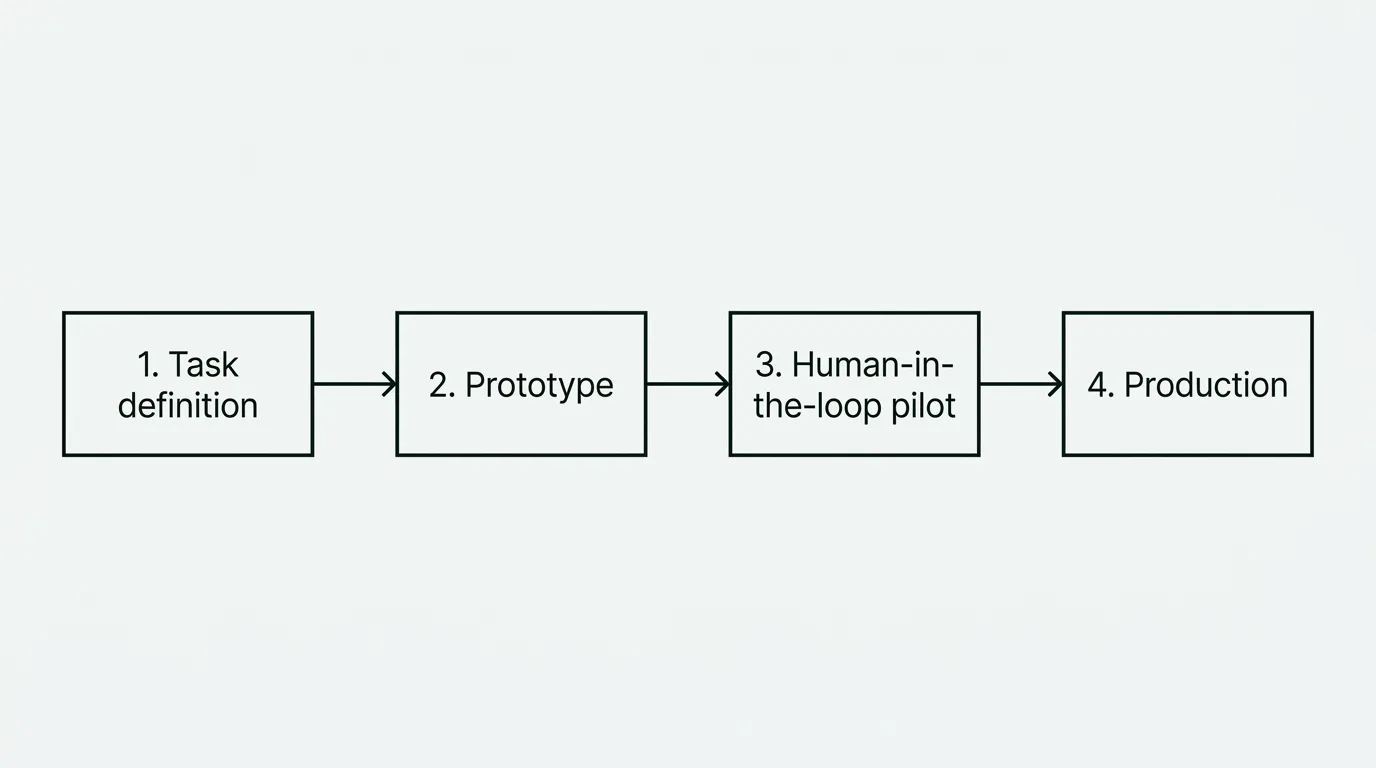
Step 1: define the task more narrowly than you want to
The most common cause of failure is not technical — it is a task defined as "an agent for customer service" instead of "an agent that classifies requests and drafts replies to order-status questions". A good definition fits in one sentence and contains: the input (what the agent receives), the output (what it must deliver), and the boundary (what it may not decide on its own). If you cannot name the boundary, you are not ready to build yet — check our readiness checklist for a first AI implementation.
Step 2: pick a build route (and know what each costs)
| Route | Ballpark cost | Best for |
|---|---|---|
| DIY on a low-code platform (n8n, Make, model providers' builders) | server + model API: tens to a couple of hundred dollars/month + your time | simple tasks, someone technical on the team, low cost of error |
| Prototype with an implementation team | typically a few thousand dollars for a working proof of concept on one process | verifying viability before investing in a full rollout |
| Full production rollout | from several thousand dollars up, depending on integrations | critical processes, many systems, security requirements |
These ranges are orientation, not a price list — an honest quote always starts with process analysis. More important than the figures is something else: the cost of maintenance. An agent is not a "done and forgotten" project — models change, provider APIs change, and the company process evolves. Budget a small, ongoing care cost (updates, quality monitoring); without it, agents degrade quietly.
Step 3: build the prototype on real data
Whatever the route, a prototype is built the same way: take a few dozen historical examples of the process (real ones, typical and hard cases alike), configure the agent (model + boundary-bearing prompt + the tools it needs), and compare its output against how a human did the job. A prototype's result is a number — the share of cases the agent got right — not an impression from a demo. How to run that test before committing to a full build is covered in our piece on the AI proof of concept.
Step 4: a human-in-the-loop pilot
For its first weeks the agent should work in assistant mode: it prepares the result, a human approves before anything goes out. This is the stage where mistakes are cheap and the company gathers quality data. Only when the correction rate drops and stabilises should some cases move to full automation — with the escalation path kept intact for out-of-scope cases.
Security — the section most guides do not have
- Personal data — before the agent touches customer data, establish where that data flows (a model provider's API means processing outside your company; check the data-processing agreement and processing location — GDPR does not vanish because the tool is new).
- Prompt injection — an agent reading customer-supplied content can receive instructions inside it ("ignore your rules and…"). Minimum defence: structured output, restricted tools, validating results before any action.
- Secrets — API keys in the platform's credential manager, never inside prompts or workflows.
- Accountability — log every agent decision with its input and output; without that you cannot reconstruct why a customer received the answer they did.
A realistic timeline
A simple agent on one process: prototype in 1–2 weeks. A rollout with integrations and a pilot: 4–8 weeks to stable operation — with the integrations usually taking longer than the agent itself. We break this down in How long does AI agent integration take.
Wondering whether to build alone or with help? A comparison of the three collaboration models is in AI implementation studio vs freelancer vs agency.